language

Search

 中文简体
中文简体 English
 Español
 عربى
عربى Indonesia
Inquiry Now 
A furniture factory in Jiangsu runs two identical sofa frames down the same line. One is wrapped in PVC upholstery at roughly USD 6.20 per square metre, the other in PU upholstery at about USD 9.40. Eighteen months later the PVC sofa returns from a hotel project with a polished, shiny seat cushion and a hairline crack running along the front rail, while the PU sofa from the same shipment still feels soft and holds its embossed grain. Both materials passed the same incoming inspection. Both were sold as "leather". The difference was not quality control, it was chemistry.
That story repeats itself in car interiors, luggage lines, gym equipment and footwear programmes every month. So when a buyer, product engineer or sourcing manager asks "which is better, PVC or PU leather?", the honest answer is that neither wins outright. PVC wins specific battles, PU wins others, and the material that fails is almost always the one chosen for the wrong reason, usually unit price.
Before comparing data sheets, answer these four questions about the end product. They resolve the PVC-versus-PU debate faster than any specification table.
If the application is a high-traffic, wipe-down surface in a controlled indoor climate, PVC is normally the rational choice. If the application is a soft-touch, lightweight, breathable or low-odour surface, PU is normally the rational choice. Everything else is a negotiation between those two poles.
Both materials are coated fabrics, not hides. A "leather" label in the synthetic category describes a polymer skin bonded to a textile backing. That is why two rolls with the same name can behave completely differently: the polymer, the plasticiser or polyol, the backing and the coating process all change the outcome.
PVC artificial leather is built from polyvinyl chloride resin, softened with plasticisers such as DINP, DOTP or DIDP, then blended with calcium carbonate fillers, heat stabilisers and pigments. The paste is coated onto a knitted polyester or cotton backing, and often expanded into a foam layer to create a soft hand feel. Typical commercial constructions weigh between 480 and 900 g/m² and run from 0.5 mm to 1.5 mm thick. The plasticiser content, often 25 to 35 percent of the compound, is the single biggest variable in quality. Cheaper formulations load more filler and use lower-grade plasticiser, which is exactly why budget PVC can feel stiff at first and go tacky after two summers.
PU artificial leather uses polyurethane resin rather than PVC. The polymer can be built on polyester polyol, polyether polyol or polycarbonate polyol, and that choice determines hydrolysis resistance. Most PU is produced by transfer coating: the resin is cast onto release paper, dried, then laminated to a knit or woven backing, which allows fine grain reproduction. Microfiber PU goes further and impregnates a three-dimensional nonwoven bundle to imitate the fibre structure of real leather. PU coatings normally weigh 300 to 650 g/m², which matters for weight-sensitive products such as luggage and footwear. It is also worth knowing that PU is not automatically the greener option, because solvent-based PU carries its own emissions profile. A more detailed technical breakdown of the two chemistries is available in our comparison of the differences between PVC artificial leather and PU artificial leather.
The table below reflects typical commercial ranges from regular production runs. Treat the numbers as a starting point for specification, not as universal constants, because a well-formulated PVC can outperform a poorly formulated PU on several rows at once.
| Property | PVC artificial leather | PU artificial leather |
|---|---|---|
| Base chemistry | PVC resin, plasticiser, CaCO3 filler, stabilisers | Polyurethane resin, polyester, polyether or polycarbonate polyol |
| Typical weight | 480 to 900 g/m² | 300 to 650 g/m² |
| Hand feel | Firmer, rubbery, holds very deep embossing | Softer, warmer, reproduces fine grain detail |
| Abrasion, Martindale ISO 12947 | 25,000 to 60,000 cycles | 40,000 to 150,000 cycles, higher for microfiber |
| Flex at low temperature, ISO 5402 | Can crack below -10 °C with low-grade plasticiser | Better low-temperature flex, grade dependent |
| Hot and humid ageing | Stable, but plasticiser can migrate | Polyester-polyol grades can hydrolyse above 70 °C and 90% RH |
| Flame behaviour | Inherently self-extinguishing, but releases hydrogen chloride in smoke | Burns more readily, needs added flame retardants, can drip |
| Breathability | Low unless micro-perforated | Higher, especially microfiber constructions |
| Cleaning tolerance | Very tolerant of neutral detergents and water | Good, but some topcoats are sensitive to alcohol |
| Price index | 100 (baseline) | 120 to 180 depending on polyol and process |
| Best suited to | High-traffic, wipe-down, budget and flame-retardant surfaces | Touch-critical, lightweight, breathable and low-odour surfaces |
Durability arguments usually go wrong because people compare the wrong failure mode. PVC rarely dies from abrasion; it dies from plasticiser loss, which shows up as stiffening, shrinking and surface cracking. PU rarely dies from plasticiser loss; it dies from hydrolysis or from a topcoat that cannot take repeated flexing.
On a Martindale rig, a well-built PVC upholstery will commonly hold 25,000 to 60,000 cycles before visible surface change, which is enough for contract furniture, school seating and vehicle door panels. PU, particularly microfiber PU, frequently exceeds 100,000 cycles. If the application involves constant sliding contact, such as office chairs or luggage trolley handles, PU's higher abrasion ceiling is worth the price premium.
Flexometers bend a strip of material through a fixed angle until it cracks. Flexible PVC with a mid-range plasticiser may reach 50,000 to 150,000 cycles at room temperature but fall sharply when the thermostat drops. In unheated warehouses in northern markets, cheap PVC can crack during handling before it ever reaches a customer. Polycarbonate-based PU handles cold flex noticeably better and is the usual specification for cold-climate footwear and automotive trim.
This is PU's Achilles heel. Standard polyester-polyol PU stored or used above roughly 70 °C and 90% relative humidity can break down at the ester linkage, producing a sticky, chalky surface that peels from the backing. Polyether and polycarbonate polyols dramatically improve resistance, but they cost more. If your product ships through tropical ports, sits in a hot container or operates in a steam environment, ask the supplier for the polyol type in writing before you approve the sample.
Illustrative trend based on typical field returns; a plasticiser-stabilised PVC keeps surface integrity longer in humid heat, while standard polyester PU loses strength faster once hydrolysis begins.
The per-metre quotation is the least useful cost figure in a synthetic leather project. What matters is cost per year of service, and that number includes the replacement labour, the transport of a second shipment and the reputational damage of a failing surface.
Take a hospitality seating project with 100 m² of visible upholstery. Standard PVC at USD 6.20 per metre costs USD 620 for the first covering. Contract-grade flame-retardant PVC at USD 7.80 costs USD 780. Coated PU at USD 9.40 costs USD 940, and microfiber PU at USD 12.00 costs USD 1,200. If the low-cost PVC needs recovering in year three and the FR-grade PVC survives six years while both PU options reach year eight without replacement, the ranking flips completely.
Bars scaled to a USD 2,200 maximum. Labour, freight and downtime are estimated at 60% of the material cost for a single recovery.
Touch is where PU enjoys its clearest advantage. Polyurethane topcoats can be formulated to feel dry, waxy or silky, and the transfer-coating process reproduces fine grain detail that PVC tends to flatten out. Microfiber PU adds a fibre bundle structure that gives a springy, compressible hand feel much closer to grain leather.
Breathability follows the same pattern. A solid PVC coating blocks vapour almost completely, so a PVC seat can feel clammy after twenty minutes of contact. Micro-perforated PVC improves airflow but collects dust in the holes. PU, and especially microfiber PU, allows some moisture vapour transmission because the polymer structure is more open. Neither material equals a genuine hide, but the gap between a cheap PVC and a good microfiber PU is obvious to any customer who sits on both.
Weight is the third comfort factor. PU at 350 g/m² saves roughly 200 to 300 grams per square metre compared with a comparable PVC. On a 22-inch carry-on suitcase that is a meaningful shipping and handling difference, and in footwear it changes how the shoe breaks in over the first week.
Compliance is the area where a cheap material quietly becomes an expensive one. Two synthetic leathers can look identical in a sample book and sit on opposite sides of a regulation.
Restricted phthalates such as DEHP, DBP, BBP and DIBP are limited under REACH Annex XVII entry 51 for articles in the European market, and similar restrictions apply to children's products in North America. The practical consequence is that a compliant PVC must be produced with non-restricted plasticisers such as DINP or DOTP, which raises the raw material cost. PVC also generates hydrogen chloride during combustion, which is why automotive and rail specifications impose smoke density and toxicity limits beyond simple flammability ratings.
Solvent-based PU production can leave dimethylformamide or toluene residues if the drying and washing stages are not properly controlled. Water-based and solvent-free PU systems largely remove this risk, and they also cut odour noticeably. For sealed interiors such as car cabins, vehicle interior air quality tests such as VDA 270 for odour and DIN 75201 for fogging are standard acceptance criteria, and PU is judged on both just as strictly as PVC.
Whichever polymer you choose, expect to supply evidence on restricted amines in azo dyes, heavy metals, total volatile organic compounds, and in some markets polycyclic aromatic hydrocarbons. Textile eco-labels remain the fastest way to prove the whole construction, not just the coating, meets a recognised threshold.
The debate resolves much faster when it is applied to a specific product. Below are the six categories where the choice is most frequently contested in real purchasing decisions.
Vehicle cabins demand abrasion resistance, colour fastness to rubbing, low fogging and flame behaviour. PVC still dominates door panels, lower instrument panels and many seat bolsters because it embosses deeply, tolerates cleaners and self-extinguishes. Its liabilities are plasticiser fogging on the windscreen and a firmer feel. PU wins on steering wheels, headliners and premium seat surfaces where soft touch and low gloss matter. A practical compromise used by many programmes is PVC on high-wear lower surfaces and PU on contact surfaces.
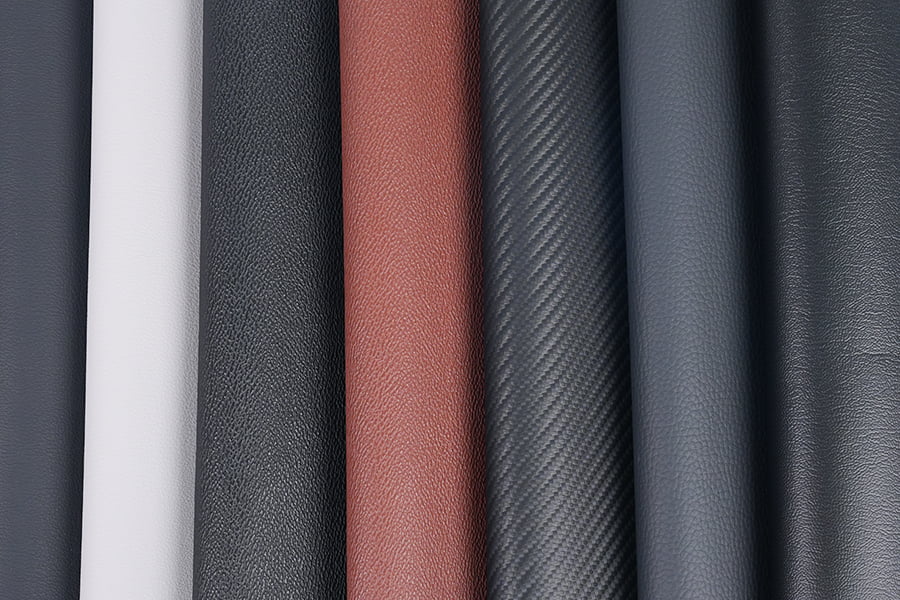 High Wear-Resistant PVC Car Interior LeatherHigh wear-resistant PVC car interior leather is a high-performance fabric designed for car interiors, suitable for a variety of interior decoration materials such as c...View Product →
Households with small children generally do better with PVC, which shrugs off spilled juice and can be wiped with a damp cloth without changing colour. Households buying on comfort will prefer PU, because a PU sofa simply feels warmer in a cold room and does not squeak in the same way. The failure to watch for is plasticiser migration on PVC, where the covering sticks to itself and picks up dye from whatever it touches during storage. Look for a compatible topcoat and a stated migration test result.
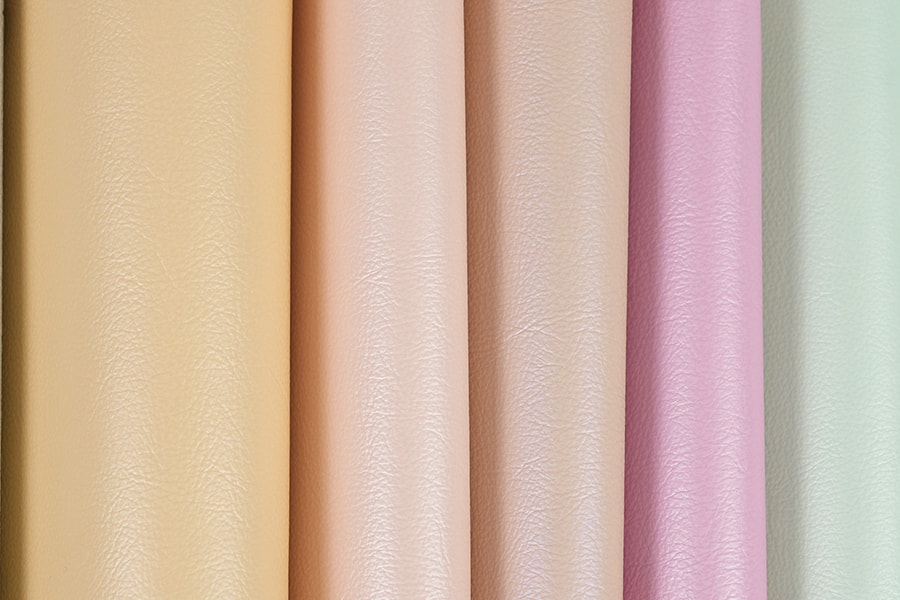 Soft-Touch Anti-Stain Faux Leather for SofasOur Soft-Touch Anti-Stain Faux Leather for Sofas is made from high-quality PVC/PU leather, boasting a fine, soft surface texture, a natural grain, and a comfortable fe...View Product →
For buyers assembling a full upholstery programme, our sofa synthetic leather range covers both soft-touch and heavy-duty constructions in the same colour standards, which avoids the shade mismatch that appears when PVC and PU are sourced from different suppliers.
Luggage is a weight business. PU's lighter coating gives a genuine advantage on cabin bags and soft-sided trolleys, and fine grain reproduction suits fashion handbags. PVC retains an advantage where a strong embossed statement surface is required, such as crocodile grain, and where the case is expected to be dragged across airport floors. A high-frequency weldable PVC also simplifies some manufacturing steps.
Shoe uppers live with constant flexing and moisture. PU, particularly polycarbonate-based grades, handles flex fatigue and cold crack far better, which is why most mid-market uppers are PU. PVC appears more often in linings, children's sandals and waterproof wellington-style boots, where its low moisture vapour transmission and easy welding are actually benefits.
This is a surprisingly balanced category. Benches and pads experience sweat, body oils and repeated compression, and PVC's wipeable surface and inherent flame resistance are attractive. However, salt and sunscreen accelerate plasticiser extraction, leaving a tacky surface within a season in busy gyms. PU with a protective topcoat resists this better but needs an added flame retardant package to pass the safety tests that insurers increasingly demand.
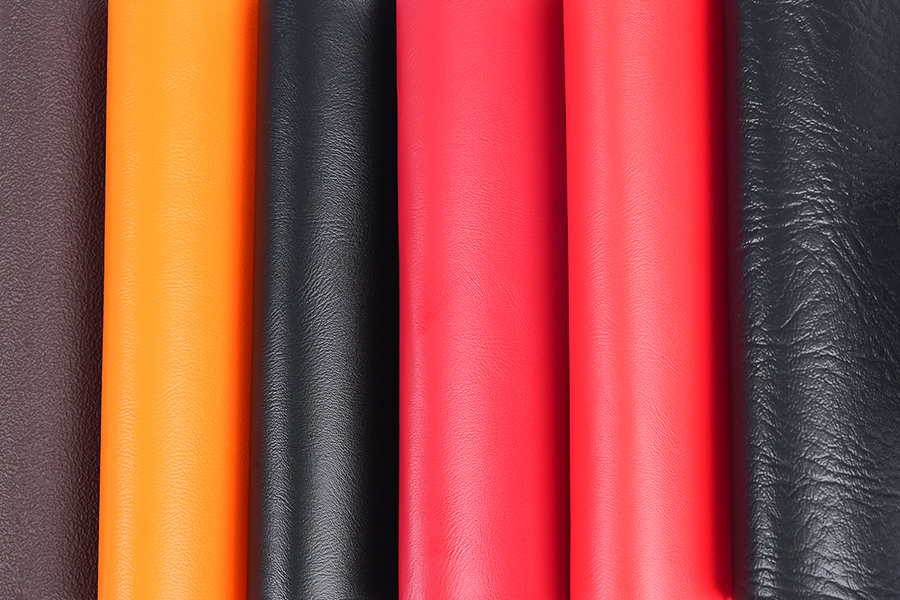 Sweat-Proof Fire-Retardant Faux Leather for Fitness EquipmentSweat-Proof Fire-Retardant Faux Leather is designed specifically for fitness equipment. It's durable and wear-resistant, maintaining a smooth, crack-free, and blister-...View Product →
Wall panels and soft wall covering are driven by odour and indoor air quality rather than abrasion. PU's lower plasticiser content and lower odour profile make it the safer default for hotels, clinics and residential projects, while PVC remains competitive in high-moisture areas such as bathrooms and service corridors where mildew resistance and cleanability outrank feel.
Most complaints that reach a supplier are traceable to a specification that never stated the critical property. A single page of acceptance criteria prevents almost all of them. The checklist below covers the values that actually cause disputes.
| Parameter | Typical requirement | Why it matters |
|---|---|---|
| Total weight | Stated grams per square metre, tolerance plus or minus 5% | Low weight usually means more filler and less polymer |
| Thickness | Stated millimetres, tolerance plus or minus 0.05 mm | Affects flex life, welding and stitching behaviour |
| Roll width and length | 137 or 142 cm, tolerance plus or minus 1%, nominal 50 m rolls | Short rolls increase cutting waste and unit cost |
| Abrasion | Minimum Martindale cycles for the intended use | The single best proxy for surface lifespan |
| Flex and cold crack | Minimum cycles at the lowest expected service temperature | Prevents cracking during winter transport |
| Colour fastness to rubbing | Wet and dry rating agreed against a reference swatch | Prevents dye transfer to clothing and white upholstery |
| Plasticiser or polyol type | Named in writing, not described as "eco-friendly" | Determines compliance and hydrolysis resistance |
| Flame performance | Named test method and pass threshold | Acceptance criteria differ by market and sector |
| Odour and emissions | Odour rating and VOC limit if the product is enclosed | Critical for vehicle cabins and sealed furniture |
Two additional habits separate experienced buyers from everyone else. First, always approve a production sample from the actual line that will run your order, not a laboratory swatch, because plasticiser dosing and oven temperatures drift between lines. Second, keep a retained reference of the approved sample sealed and dated, since colour and hand feel disputes after six months are impossible to settle without one.
Usually, yes. At comparable thickness, PU typically carries a 20 to 80 percent price premium because polyurethane resin costs more than PVC compound and the transfer-coating process is slower. The premium narrows when the PVC is a compliant, low-migration, flame-retardant grade.
It depends on the failure mode you are exposed to. In dry, abrasive, wipe-down environments PVC frequently lasts longer. In hot, humid, flexing environments a properly specified PU, especially polycarbonate or polyether based, outlasts standard PVC by a wide margin.
It is better than solid PVC but still far behind a genuine hide or a woven fabric. If breathability is the priority, microfiber PU with micro-perforation is the best available synthetic option.
Yes, and it is widely used on door panels, lower trim and seat bolsters. The constraints are fogging, plasticiser migration and smoke toxicity, all of which can be managed with the right plasticiser and topcoat system.
It should not if it is sold into regulated markets. Compliant production uses non-restricted plasticisers, and this must be confirmed in writing with test reports rather than assumed from the word "eco" on a sample card.
Microfiber PU is a subset of PU leather. The coating chemistry is similar, but the backing is a three-dimensional microfiber nonwoven rather than a knit, which gives a higher abrasion ceiling, a softer hand feel and better moisture vapour transmission.
A plasticiser-stabilised PVC is generally safer in constant humidity, because it does not hydrolyse. If PU is required for feel, specify a polyether or polycarbonate polyol and confirm hydrolysis test results.
PVC is easier to clean and harder to damage, but it must be certified free of restricted phthalates and heavy metals. A soft-touch anti-stain PU is often chosen for the tactile experience even though it costs more and stains slightly more easily.
If you are weighing PVC against PU for a specific product, the fastest route to a decision is a comparative sample set rather than a longer data sheet. Send us the application, the expected service life, the target market and the failure you are most worried about, and we will match a PVC grade and a PU grade on the same backing, colour standard and thickness so you can run real seam, weld, abrasion and flex tests on identical starting points. That comparison takes about two weeks and settles the argument permanently, because by then the decision is based on your own production floor rather than on a general rule that was never true for every application.
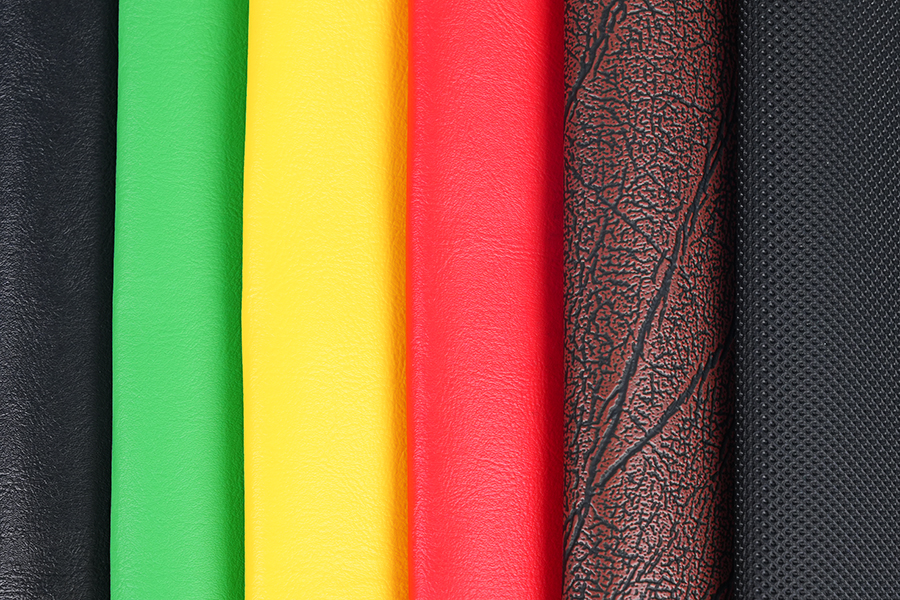
The Versatility of Sofa Artificial Leather in Different Home Decor Styles Sofa artificial leather has gained significant popularity as a material for home furniture, owing to its impressive versatilit...
View MoreIntroduction to Synthetic Leather What is Synthetic Leather? Definition and overview: Synthetic leather, also known as faux leather, vegan leather, or artificial leather, is a man-made material desig...
View MorePVC (Polyvinyl Chloride) and PU (Polyurethane) are two popular materials used in the production of automotive synthetic leather, each with its unique characteristics. Below are the key differences: Ma...
View MoreIntroduction of Synthetic Leather for Shoes What Is Synthetic Leather? Synthetic leather refers to any man-made material designed to imitate the appearance, texture, and qualities of genuine leather. ...
View MoreCopyright © Fu'an Synthetic Materials Co.,Ltd. Rights Reserved.
 Privacy
Custom PVC Synthetic/Artificial Leather Manufacturers
Privacy
Custom PVC Synthetic/Artificial Leather Manufacturers