language

Search

 中文简体
中文简体 English
 Español
 عربى
عربى Indonesia
Inquiry Now 
A furniture maker shipped 600 upholstered sofas wrapped in a soft-touch faux leather. Fourteen months later, the service calls arrived in a pattern the quality team had not predicted. The seat cushions were lifting along the seam lines, the armrests felt tacky to the palm, and the panels facing a window had gone a dull, milky shade. The sample had passed every test the factory ran before production started. Nothing about the material was defective in any legal sense. It simply reached the end of its useful behavior earlier than the customer expected, and it did so in the exact places where heat, friction and skin contact combine.
That gap between "passes the lab test" and "survives the sofa" is the honest answer to the question of what the downside of faux leather is. Faux leather is not one material. It is a family of coated and laminated composites: a polymer skin made of PVC, polyurethane or a blend, a printed or embossed surface, a tie coat or adhesive layer, and a textile backing. Every layer reacts differently to heat, humidity, ultraviolet light and repeated flexing. A hide is a single fibrous structure that wears down gradually. Faux leather is a stack, and it fails at the weakest interface between two layers.
Here is the conclusion first, before the explanations: the downsides of faux leather are rarely about appearance. They are about breathability and heat retention against the skin, peeling and delamination after flex and heat aging, a narrow working temperature range, odor and volatile organic compounds linked to plasticizers, abrasion and seam failure, ultraviolet fading and color drift, and a limited repair path combined with a difficult end of life. Each of those has a measurable threshold, and each one can be reduced at the specification stage instead of being discovered in the field.
What follows is a working guide rather than a warning. It explains what triggers each failure, which test numbers reveal it, which chemistries behave differently, and how to write the acceptance values into a purchase order so that the downside stays inside the factory instead of reaching a customer's living room.
Onset windows depend on thickness, backing type, coating weight and how the material is used. The table below reflects mid-grade material in continuous daily use, which is the scenario most buyers actually face. Premium grades with better plasticizer systems and a knitted backing can push the later stages back by 30 to 60 percent, but they cannot remove the underlying mechanics.
| Downside | How it appears in the field | Typical onset | Hardest-hit applications |
|---|---|---|---|
| No breathability | Sticky contact, damp seat surface, squeaking, sweat marks | Immediate | Vehicle seats, office chairs, gaming chairs |
| Delamination and peeling | Coating lifts away from the backing at creases and seams | 12 to 36 months | Sofa cushions, armrests, headrest edges |
| Heat sensitivity | Softening, flattened grain, glossy patches, print loss | Immediate to 24 months | Vehicle cabins, sunrooms, conservatories |
| Cold stiffening | Hairline cracks at fold lines, brittle edges in transit | Immediate | Unheated warehouses, outdoor covers, cold-chain |
| Odor and emissions | Solvent or sweet plasticizer smell that returns when warm | Immediate, recurring | Car interiors, hotel rooms, enclosed cabins |
| Abrasion and scratching | Shiny wear paths, scuff marks, seam edge fraying | 6 to 24 months | High-traffic seating, luggage, gym equipment |
| Ultraviolet fading | Yellowing, color drift between panels made in different batches | 6 to 18 months near glass | Window-side sofas, boat interiors, awnings |
| Repair and disposal | No refinishing route, visible patches, landfill or energy recovery | At disposal | Contract furniture, hospitality, healthcare |
The pattern worth noticing is that the cosmetic complaints arrive first and the structural ones arrive second. A buyer who only inspects a new sample will see a flawless surface, because the failure modes that matter most are all time and temperature dependent.
A coated or laminated polymer film is effectively closed. Measured air permeability on PVC and standard PU upholstery coatings often falls below 1 mm/s under ISO 9237, while a woven textile of comparable weight can pass 50 to 200 mm/s. That single number explains most of the comfort complaints.
When a person sits on a sealed surface, perspiration has nowhere to go. Research on thermal comfort in vehicle seating has repeatedly shown that interface temperature and humidity at the seat surface, not the surface material's softness, drive the perception of discomfort on journeys longer than 30 minutes. The consequence is a tacky sensation, damp clothing, a faint rubbing sound during movement, and in warm conditions a patch of visible moisture on the seat pan.
Moisture trapped between the coating and the backing is the same moisture that drives hydrolysis in polyester-based PU and speeds plasticizer migration in PVC. A seat that feels clammy is also a seat where the adhesive layer is aging faster than the design intended. In healthcare and hospitality settings, retained moisture in the backing can support odor-causing bacteria, which is why some facility managers reject coated covers outright in favor of breathable woven textiles.
Peeling is not a defect that appears by accident. It is a bond failure between the coating and the backing, and it follows a predictable path. The top coat loses flexibility through plasticizer loss or polymer aging, micro-cracks form along the crease lines where the material folds every time someone sits down, moisture and heat reach the adhesive layer through those cracks, and the coating begins to lift in sheets.
Two test methods separate a material that will peel from one that will not. Flex fatigue under EN ISO 5402-1 or ISO 32100 runs the sample through 100,000 to 150,000 bending cycles at minus 10 degrees Celsius and then checks for cracking at three times magnification. Hydrolysis resistance for polyester-based PU runs the sample at 70 degrees Celsius and 95 percent relative humidity for seven weeks and then measures retained tensile strength. A coating that loses more than 30 percent of its original tensile strength in that window should not be specified for a humid climate.
The practical implication for a buyer is that a five-year warranty on a coated cover is a promise about chemistry, not about thickness. Increasing coating weight from 0.6 mm to 0.9 mm delays the cosmetic stage but does nothing for an adhesive that is not hydrolysis resistant.
PVC-based faux leather begins to soften and lose its embossed grain somewhere between 60 and 80 degrees Celsius, depending on plasticizer loading. That range is easy to exceed. A parked car with closed windows reaches 65 to 75 degrees Celsius on the dashboard and 55 to 65 degrees Celsius on the seat surface in summer. A print that looked sharp in the sample room can flatten into a glossy patch within a single season.
Polyurethane coatings tolerate short exposure to 90 to 100 degrees Celsius better and hold their grain longer, which is one reason automotive interiors have moved steadily toward PU and PU-PVC blends. The trade-off is that PU is more sensitive to prolonged humidity, which is exactly the condition a car interior in a coastal city provides.
PVC transitions from flexible to brittle in the region of minus 20 to minus 30 degrees Celsius depending on formulation. Fold a roll of material that has spent a night in an unheated container, and the crack line will appear immediately. Cold crack testing to ISO 8570 or ASTM D1790 at minus 20 degrees Celsius is a standard requirement for anything shipped or stored outside a climate-controlled space.
For dimensional stability, a reasonable acceptance value for interior work is a change of no more than 1 percent after 24 hours at 80 degrees Celsius. Beyond that, a sewn cover can pull away from its frame, and a wrapped panel can wrinkle at the corners.
The smell of new faux leather comes from three sources: residual solvent from the coating line, plasticizers that were never fully bound into the PVC matrix, and stabilizers and flame retardants added for performance. None of them stay inside the material forever.
In vehicle interiors, the accepted measurement system is a set of VDA methods. Odor is rated on a scale from 1 to 6 under VDA 270, and most vehicle programs require a rating of 3.0 or better, with premium brands asking for 2.5 or below after three hours at 80 degrees Celsius. Volatile organic compound and fogging behavior are measured under VDA 278, with common limits around 100 micrograms per gram for VOC and 250 micrograms per gram for fog. A material that fails fog testing deposits a thin film on the inside of a windshield, which is a visible defect the end user pays to remove.
Plasticizers do not stay in the sheet. They migrate into anything they touch, which is why a vinyl dashboard can turn a polycarbonate trim panel cloudy, why a printed logo on a chair back can blur, and why a coated surface that was matte in year one looks wet in year three. Phthalate plasticizers such as DEHP, DBP, BBP, DINP and DIDP are restricted under REACH Annex XVII for many consumer articles and are on the California Proposition 65 list. RoHS restrictions apply to electrical products that incorporate a coated cover.
Coated fabric resists abrasion well in one direction and poorly in another. A PVC coating can outperform many woven textiles in a Martindale test while scratching visibly the first time a metal buckle drags across it. Both facts are true at the same time, which is why a single number is never enough.
| Property | Test method | Typical acceptable value |
|---|---|---|
| Martindale abrasion | ISO 12947-2 | 25,000 rubs domestic, 40,000 to 100,000 rubs contract |
| Wyzenbeek abrasion | ASTM D4157 | 15,000 double rubs heavy duty, 30,000 for high traffic |
| Seam strength | ISO 13935-1 | 250 N per 50 mm minimum for upholstery |
| Flex fatigue | EN ISO 5402-1 | 100,000 cycles at minus 10 degrees Celsius, no cracking |
| Cold crack | ISO 8570 | No cracking at minus 20 degrees Celsius |
| Light fastness | ISO 105-B02 | Grade 5 to 6 furniture, grade 6 to 7 automotive |
Seam behavior deserves separate attention. Slippery PVC coatings allow yarn to pull out of a seam under load, a phenomenon known as seam slippage. Combined with needle cuts created during stitching, the seam line becomes the first place a cover opens. Specifying a bonded or laminated backing with sufficient friction, and testing seam strength on the finished cover rather than on flat goods, closes this gap.
Sunlight degrades every polymer, but it does so at different rates and in different ways. PVC with an inadequate stabilizer package yellows. Pigments migrate toward the surface and produce a chalky appearance. A PU top coat can lose gloss unevenly, leaving a pattern that follows the direction of the light rather than the shape of the furniture.
The standard measurement is the blue wool scale under ISO 105-B02. Furniture generally requires grade 5 to 6, while automotive interior specifications typically demand grade 6 to 7. Xenon arc exposure under ISO 4892-2 gives a more realistic picture over weeks rather than hours, with furniture programs commonly requiring 250 kilojoules per square meter and automotive programs reaching 450 or more.
The most damaging fading complaint is not a uniform color change. It is a mismatch between panels produced at different times. A sofa whose back cushion was cut from batch A and whose seat cushion came from batch B can fade into two visibly different tones within a year. Buyers should require that pigment lots be recorded per roll and that a retained sample be kept for at least 24 months, so a genuine mismatch can be distinguished from ordinary aging.
A hide can be cleaned, conditioned and recolored by a technician in a customer's home. A bonded faux leather cannot. Its surface is a film, not a fiber structure, so a repair is either an invisible patch in a low-visibility area or a complete re-cover. Delamination in particular is not reversible, because the adhesive interface has been destroyed rather than damaged.
The financial consequence is easy to underestimate. In a 12-piece restaurant banquette, one delaminated module cannot be refinished to match its neighbors, and a partial re-cover rarely matches the aged tone of the remaining eleven. Operators frequently replace more material than the damage itself would justify.
This is where newer chemistries matter. Bio-based and recyclable substrate systems, including PBS-based synthetic leather, offer a different end-of-life profile and are becoming a realistic specification option for programs with published sustainability targets. They do not remove the performance downsides described above, but they change the disposal equation.
Most disagreements about faux leather quality are really disagreements about chemistry. The same complaint, peeling, has a different cause in each family, and each family carries its own weakness profile.
| Factor | PVC-based faux leather | PU-based faux leather |
|---|---|---|
| Abrasion resistance | High, often the strongest performer | Good, varies widely by grade |
| Plasticizer migration | Significant risk, causes tackiness and fogging | Low to none |
| Hydrolysis resistance | Generally good | Weak if polyester-based, good if polyether-based |
| Cold flexibility | Poor below minus 20 degrees Celsius | Better, down to minus 30 degrees Celsius |
| Odor and VOC | Higher, driven by plasticizers and stabilizers | Lower, driven by residual solvent |
| Hand feel and drape | Firmer, more plastic | Softer, closer to a hide |
| End of life | Chlorine content complicates disposal | Isocyanate emissions when burned |
If you are weighing the two families for a specific program, a full comparison of PVC artificial leather and PU artificial leather covers the mechanical and chemical differences in more detail. The short version for procurement is that PVC wins on abrasion and cost, PU wins on feel, low emissions and cold performance, and both lose to hydrolysis or plasticizer migration if the specification ignores the end environment.
Failures rarely arrive one at a time. Plasticizer loss makes the surface harder, harder surfaces crack at creases, cracks let moisture reach the adhesive, and the adhesive releases. The chart below models a mid-grade PU cover in daily domestic use, where retained performance is expressed as a combination of tensile strength, flex life and surface integrity.
100%
Year 1
96%
Year 2
88%
Year 3
74%
Year 4
55%
Year 5
Data represents typical mid-grade material. Hydrolysis-resistant grades with a knitted backing commonly retain 70 to 80 percent at year five.
The second chart shows where field claims actually cluster across upholstery programs. Bond failure dominates, which is why flex and hydrolysis testing usually returns more value per dollar than adding coating weight.
Figures reflect aggregated service data from coated upholstery categories including furniture, vehicle interiors and luggage.
Every downside listed above has an application where it barely matters. The mistake is treating faux leather as a single commodity and applying one grade everywhere.
Vehicle cabins combine the three hardest conditions: sustained heat, ultraviolet exposure through glass, and abrasion from entry and exit. A high-wear PVC car interior leather formulated with a phthalate-free plasticizer system and tested to VDA 270 and VDA 278 targets handles this environment well, because PVC's abrasion performance and dimensional stability outperform softer alternatives in areas that never touch skin directly. Panels that touch skin for hours, such as seat cushion centers, benefit from perforation or a breathable PU option.
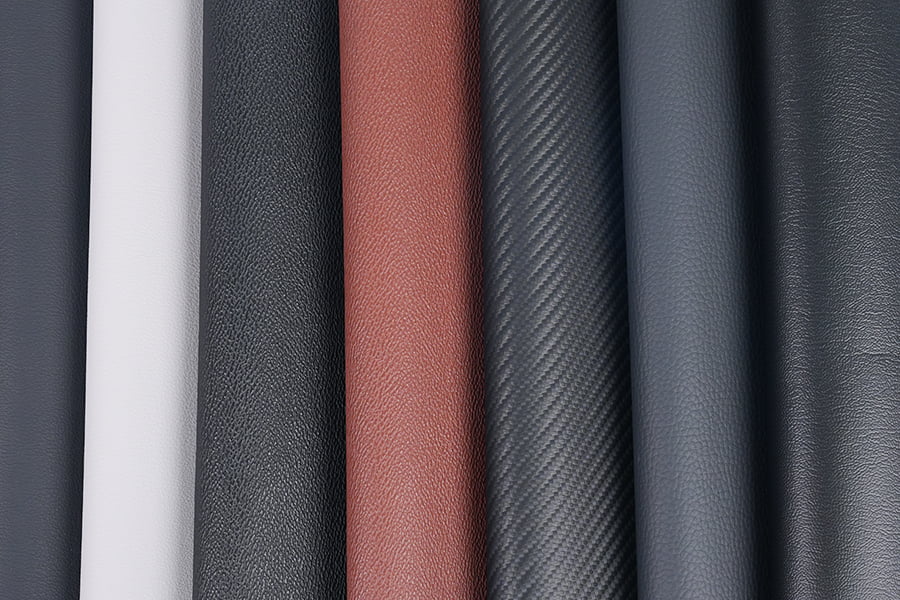 High Wear-Resistant PVC Car Interior LeatherHigh wear-resistant PVC car interior leather is a high-performance fabric designed for car interiors, suitable for a variety of interior decoration materials such as c...View Product →
Domestic seating fails through staining and flex fatigue more often than through abrasion. Spilled coffee, pet claws and sunscreen transfer are the realistic threats, and a soft-touch anti-stain faux leather keeps its appearance longer than a heavy abrasion-focused grade that feels stiff. Specify stain resistance through a test for oil and water repellency, and confirm the flex fatigue result at minus 10 degrees Celsius even for indoor furniture, because unheated delivery and storage still expose the roll to low temperatures.
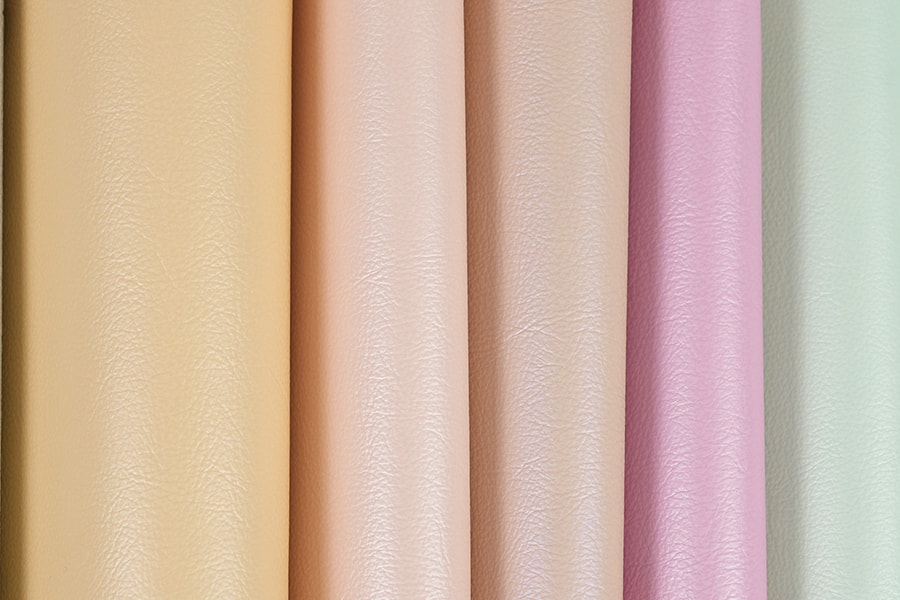 Soft-Touch Anti-Stain Faux Leather for SofasOur Soft-Touch Anti-Stain Faux Leather for Sofas is made from high-quality PVC/PU leather, boasting a fine, soft surface texture, a natural grain, and a comfortable fe...View Product →
Gym equipment is a hostile environment in a way that is often underestimated. Sweat is mildly acidic and stays in contact for hours, the surface is wiped with disinfectant daily, and the padding flexes under load. A sweatproof fire-retardant faux leather addresses the two dominant failure routes at once: surface degradation from perspiration and compliance with flame spread requirements for commercial fitness areas. Flame performance for furniture is usually verified against California TB 117-2013 or an equivalent national standard.
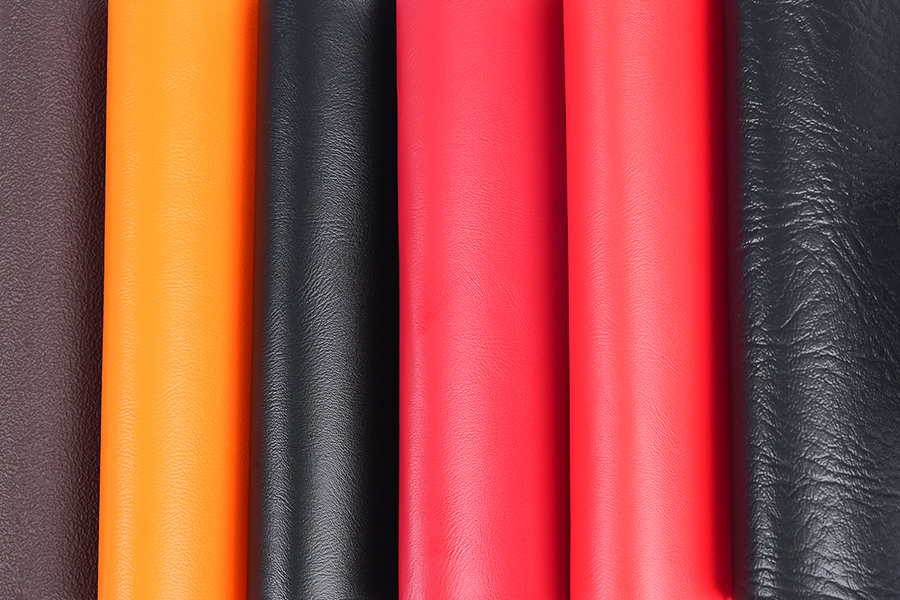 Sweat-Proof Fire-Retardant Faux Leather for Fitness EquipmentSweat-Proof Fire-Retardant Faux Leather is designed specifically for fitness equipment. It's durable and wear-resistant, maintaining a smooth, crack-free, and blister-...View Product →
These applications expose the material to sharp edges, repeated folding and rough handling. Lightweight scratch-resistant material with a woven or nonwoven reinforcement behind the coating survives far better than a soft decorative grade. For footwear, breathability becomes a comfort requirement again, and a breathable anti-wrinkle grade reduces the crease cracking that appears across the toe box.
Wall and panel applications rarely see abrasion, so the priorities shift to odor, emissions and dimensional stability. An environmentally friendly odorless interior decoration leather avoids the most common complaint in finished rooms, which is a persistent smell that appears when a space is closed and warm.
Phthalate-free plasticizer declaration, REACH SVHC statement, VDA 270 odor at 3.0 or better, VDA 278 VOC and fog limits, RoHS statement where electronics are involved.
Martindale or Wyzenbeek result at the correct end use level, flex fatigue at minus 10 degrees Celsius, seam strength on finished goods, tear resistance values.
Light fastness grade on the blue wool scale, xenon arc exposure value, heat aging dimensional change under 1 percent, cold crack result at minus 20 degrees Celsius.
Batch and pigment lot traceability, retained samples held for 24 months, roll-to-roll color tolerance in Delta E, coating weight variation across the roll.
Writing those four groups into a purchase order turns a subjective argument about quality into a measurable one. The following sequence is the order that usually saves the most money in claim prevention.
There are real situations where a coated cover is the better engineering choice, and the usual objections do not apply.
If the choice being evaluated is between a coated fabric and a hide, the cost-per-year comparison changes the answer far more than the purchase price does. A detailed comparison of faux leather versus real leather works through the maintenance and replacement math for both options.
Not necessarily. Peeling is a bond failure between the coating and the backing, and it can happen in expensive material if the adhesive system is not matched to the end environment. A flexible top coat with a weak tie coat will delaminate faster than a cheaper material with a hydrolysis-resistant adhesive. The reliable indicator is flex fatigue data at low temperature, not price.
In continuous daily use, a mid-grade coated cover typically looks acceptable for three to five years, while a well-maintained hide reaches ten to fifteen. The gap narrows significantly when the coated material is specified for the right application and tested for hydrolysis, and it widens dramatically when a low-cost grade is used in a hot or humid environment.
No. PU wins on odor, feel and low-temperature flexibility, but polyester-based PU is vulnerable to hydrolysis in hot, humid conditions where PVC performs more predictably. PVC also usually offers higher abrasion resistance. The right choice depends on which failure mode dominates the application, and in many cases a blend or a layered construction gives the best balance.
Delamination cannot be reversed, because the adhesive interface has been destroyed. A surface scuff can sometimes be treated with a color-matched coating, and a small damaged panel can be patched, but the patch will rarely match the aged tone of the surrounding material. In practice, repair means replacement of the affected module or the whole cover.
New coated material carries residual solvent and plasticizer odor, and most of it dissipates within a few weeks in a ventilated space. The problem is that the smell can return whenever the material is heated, because plasticizers continue to migrate. An odor rating of 3.0 or better under VDA 270 after three hours at 80 degrees Celsius is the practical threshold to specify.
It is a different set of impacts rather than a simple ranking. Coated fabric avoids the agricultural and tanning impacts associated with hides but depends on petroleum-based polymers, and its textile-plastic laminate structure makes end-of-life recycling difficult. Bio-based and recyclable substrate options reduce that burden, and they are worth specifying where a program has published material targets.
Flex fatigue at low temperature, measured on a production batch rather than a development sample. It reveals adhesive quality, top coat flexibility and plasticizer stability at the same time, and it correlates more closely with real field complaints than any other single test.
The Versatility of Sofa Artificial Leather in Different Home Decor Styles Sofa artificial leather has gained significant popularity as a material for home furniture, owing to its impressive versatilit...
View MoreIntroduction to Synthetic Leather What is Synthetic Leather? Definition and overview: Synthetic leather, also known as faux leather, vegan leather, or artificial leather, is a man-made material desig...
View MorePVC (Polyvinyl Chloride) and PU (Polyurethane) are two popular materials used in the production of automotive synthetic leather, each with its unique characteristics. Below are the key differences: Ma...
View MoreIntroduction of Synthetic Leather for Shoes What Is Synthetic Leather? Synthetic leather refers to any man-made material designed to imitate the appearance, texture, and qualities of genuine leather. ...
View MoreCopyright © Fu'an Synthetic Materials Co.,Ltd. Rights Reserved.
 Privacy
Custom PVC Synthetic/Artificial Leather Manufacturers
Privacy
Custom PVC Synthetic/Artificial Leather Manufacturers