language

Search

 中文简体
 English
 Español
 عربى
 Indonesia

Inquiry Now 
Content
A well-specified PVC synthetic leather car interior stays serviceable for five to eight years of everyday driving. Park that same car outdoors in a hot climate and the window shortens to three to five years before visible ageing appears on the seats and dash. Keep it garaged, clean it on a schedule, and eight to ten years is a realistic outcome.
That spread is not a hedge. It reflects how much the answer depends on coating build, base fabric selection, the plasticizer system and where the material sits inside the cabin. Two cars fitted with visually identical upholstery can differ by three or four years of service life simply because one dashboard takes full afternoon sun and the other spends its life under a covered shelter.
Three to five years. Sun exposure on the dash top and rear parcel shelf drives the timeline far more than mileage does.
Five to seven years. Most cabins that see occasional shade and routine cleaning settle in this band.
Eight to ten years. The upholstery comfortably outlasts the average ownership cycle.
Two to four years. Constant entry and exit wears bolsters and seat edges long before the cushion centres show anything.
| Usage profile | Heat and UV load | Typical service life | First area to age |
|---|---|---|---|
| Daily commuter, outdoor parking, hot climate | High | 3 to 5 years | Dash top, rear parcel shelf |
| Daily commuter, outdoor parking, temperate climate | Medium to high | 5 to 7 years | Driver-side bolsters |
| Weekend car, garaged | Low | 8 to 10 years | Seat edges, stitching lines |
| Ride-hailing, taxi and shuttle fleets | High friction | 2 to 4 years | Cushion front edge, sill trim |
| Executive and shuttle second row | Medium | 6 to 9 years | Headrest contact surface |
Read those numbers as material behaviour rather than as a product promise. A PVC skin that keeps its flexibility and its surface finish for six years in a temperate climate can look tired in three years in a coastal city where the cabin regularly hits 70 degrees Celsius and salt hangs in the air. The material is doing exactly what its formulation was designed to do; the environment is simply asking more of it.
Four construction decisions account for most of the difference between a three-year interior and a nine-year interior. None of them is visible from the showroom floor, which is why the specification sheet matters more than the swatch book.
The surface treatment is the thinnest part of the laminate and the first thing occupants touch. A well-built automotive top coat combines a base PVC skin with a thin finishing layer that controls gloss, adds scratch resistance and slows the migration of plasticizer to the surface. A surface that reaches about 0.40 mm carries meaningfully more abrasion reserve than a 0.20 mm decorative film, and the extra thickness buys roughly two additional years in a high-friction position such as a seat bolster.
The backing decides how the material behaves under tension, heat and repeated flexing. Knitted polyester gives softness and stretch and suits contoured seat cushions. Woven polyester holds dimensional stability better on large flat panels such as door cards and dash fascias. Non-woven backings save weight and cost but tend to relax and flatten under sustained compression. A base fabric that is too loosely constructed lets the coating crack from underneath, which is why base weight and yarn density are worth specifying explicitly.
PVC flexibility comes from plasticizer, and the choice and loading level of that plasticizer shape the long-term feel of the surface. A balanced system keeps the leather supple through thousands of heat cycles. Overloaded systems feel luxurious at first and can turn tacky once the interior has been through several summers. This is one of the few differences a buyer can catch early by requesting heat-ageing data rather than a hand feel sample.
The adhesive tie coat holds the laminate together and bonds it to the foam or substrate underneath. Poor adhesion shows up as bubbling on dash panels or lifting at seam edges, usually in the third or fourth year when the panel has expanded and contracted a few thousand times. It is also the failure mode most often mistaken for poor cleaning.
| Layer | Typical thickness | Function | How it fails with age |
|---|---|---|---|
| Surface finish | 0.02 to 0.05 mm | Scratch resistance, gloss control, soil release | Gloss build-up, fine hairline cracking |
| PVC skin | 0.15 to 0.50 mm | Colour, abrasion resistance, hand feel | Wear-through to the base fabric |
| Base fabric | 0.30 to 0.80 mm | Tensile strength, dimensional stability | Relaxation, fraying at cut edges |
| Adhesive or back coat | 0.05 to 0.15 mm | Bonding, thermoforming behaviour | Bubbling, edge lifting, delamination |
Interior ageing is rarely caused by one dramatic event. It is the cumulative result of daily cycles that most drivers never notice. The chart below ranks the relative contribution of each stress factor for a typical passenger car in a temperate to warm climate.
Heat cycling. A closed car parked in the sun can push a dark dashboard surface past 80 degrees Celsius. Every one of those cycles asks the plasticizer system to work a little harder, and the material relaxes slightly each time. Over five summers the accumulated effect is visible as a dulled, slightly stiff surface on the upper dash while the seats look untouched.
Ultraviolet exposure. UV attacks the polymer backbone at the surface rather than the bulk of the skin. That is why sun-facing panels fade and chalk before high-contact areas wear. Glass filters part of the UV spectrum but not all of it, and a sloping windscreen concentrates exposure exactly where the dashboard sits.
Mechanical friction. Seat bolsters take roughly ten times the abrasion of cushion centres because occupants slide across them on every entry and exit. Denim seams, keys and bag straps accelerate the process. Long-term abrasion data is the single most useful specification figure for this failure mode.
Humidity and body chemistry. Sweat is mildly acidic and carries salts that settle into stitch lines and perforations. Coastal air adds chloride to the mix. A leather that performs well in a dry inland city may show edge degradation considerably sooner in a humid coastal market.
Cold weather creates a different challenge on the same material. Formulations that stay supple in summer can stiffen sharply in a hard frost, and buyers sourcing for northern markets should review how the material holds cold-fold performance before signing off on a compound, as covered in our notes on maintaining low-temperature flexibility in automotive PVC synthetic leather.
A single vehicle contains a dozen different micro-environments, and each one ages the same roll of material at a different rate. Buyers comparing quotations often assume every panel needs the same grade; matching the grade to the position usually delivers longer life at a lower total cost than lifting the specification everywhere.
| Position | Dominant stress | Expected durability | Specification note |
|---|---|---|---|
| Seat cushion centre | Compression and light friction | 6 to 9 years | Standard wear layer is usually sufficient |
| Seat bolsters and backrest wings | Entry and exit abrasion | 3 to 5 years | Highest abrasion grade in the cabin |
| Door card and armrest | Hand oils, edge pressure | 4 to 6 years | Oil-resistant finish helps at the grab edge |
| Dashboard top and fascia | Peak heat and direct UV | 3 to 6 years | Heat-ageing and fogging data are critical |
| Steering wheel rim | Sweat, sunscreen, constant handling | 3 to 5 years | Chemical resistance matters more than thickness |
| Headrest and seat back | Hair oils, luggage scuffs | 5 to 8 years | Darker shades hide cosmetic ageing better |
The practical lesson for anyone planning an interior programme is that abrasion resistance should be concentrated where people slide and heat resistance where the sun lands. A cabin built entirely from one heavy-duty grade wastes budget on the headliner and under-delivers on the bolster. A cabin built entirely from a light decorative grade saves money today and produces warranty conversations in year three.
Owners and buyers tend to notice ageing in sudden jumps, but the process is steady. Here is what actually changes, and roughly when.
Surfaces carry their original gloss and grain definition. Any variation at this stage is a manufacturing issue rather than an ageing issue, which is why incoming inspection should catch colour shift, surface defects and seam alignment before the material enters production.
Bolsters take on a slight sheen where occupants slide across them. Stitch lines on the driver seat begin to deepen. The dash top, if exposed to direct sun, loses a little of its matte finish. None of this is failure; it is the material settling into its working life.
Surface gloss becomes noticeable on high-contact areas. Micro-cracking may appear at the sharpest fold of a bolster or at a seam edge. Cleaning becomes less forgiving because soil settles into micro-texture rather than sitting on top of it. A car maintained through this window typically continues comfortably; a neglected one starts to look tired.
Wear-through may reach the base fabric on a heavily used bolster. Colour on sun-facing panels has usually shifted one or two shades. Professional re-colouring and localised repair can extend appearance life by two or three years at modest cost, provided the damage is caught before the fabric layer is exposed.
The material is past its design intent in most applications. Cracking follows fold lines, adhesion weakens on thermoformed panels, and the surface no longer holds a clean finish. Replacement becomes the economical choice rather than repair.
Most complaints about automotive synthetic leather trace back to a small number of identifiable mechanisms. Recognising the pattern early usually determines whether a repair is possible.
Maintenance is the cheapest durability upgrade available to any owner, and it does not require specialist products. What it requires is regularity and a refusal to use harsh chemistry.
| Frequency | Action | Why it matters | What to avoid |
|---|---|---|---|
| Weekly | Dry-dust with a microfibre cloth | Removes grit before it becomes an abrasive | Stiff brushes that flatten the grain |
| Monthly | Wipe with diluted pH-neutral cleaner, then dry | Lifts body oils that soften the top coat | Alcohol, acetone, bleach-based wipes |
| Quarterly | Apply a water-based protectant with UV inhibitors | Slows surface oxidation and gloss drift | Solvent-heavy dressings that leave residue |
| Twice yearly | Clean and inspect seams, perforations and edges | Catches separation before it spreads | Pressure washing directly at stitch lines |
| Seasonally | Use a sunshade whenever parked in the open | Cuts peak dash temperature dramatically | Leaving the cabin sealed in full sun |
Two habits matter more than any product. First, clean spills while they are still liquid; a coffee spill that dries into a seam becomes a permanent stain rather than a temporary one. Second, shade the car. A sunshade costs very little and removes a large share of the thermal load that drives plasticizer migration and colour fade. Owners who do only those two things routinely report interiors that still look presentable well past the eight-year mark.
Durability is decided long before the first seat is trimmed. When comparing automotive PVC synthetic leather quotations, request the test data behind these six properties rather than relying on sample hand feel.
| Property | Typical test method | Indicative target | Why it predicts life |
|---|---|---|---|
| Abrasion resistance | Taber abrasion, CS-10 wheel, 500 g load | Under 100 mg loss at 1,000 cycles | Directly predicts bolster and edge wear |
| Flex resistance | Bally flex or similar repeated folding | No cracking at 100,000 cycles | Predicts seam and fold durability |
| Heat ageing | Oven ageing at 100 degrees Celsius | Limited colour shift and hardness change | Predicts dashboard and sun-facing panels |
| Colour fastness to rubbing | ISO 105-X12 wet and dry rub | Grade 4 or better | Predicts dye transfer and surface loss |
| Flammability | FMVSS 302 horizontal burn | Under 102 mm per minute | Mandatory for most passenger vehicles |
| Fogging and odour | Gravimetric fogging test | Low condensate weight | Predicts windscreen haze and cabin smell |
Flammability deserves particular attention because it cannot be corrected after the fact. Suppliers should be able to provide current test reports against the applicable market standard, and the surrounding requirements are summarised in our overview of automotive flame retardant standards.
Beyond the data sheet, ask three practical questions. What is the skin thickness at the thinnest point, not the nominal figure? What base fabric is used, and at what weight per square metre? And what is the recommended thermoforming window, because a material processed outside that window will fail early no matter how good the laminate is.
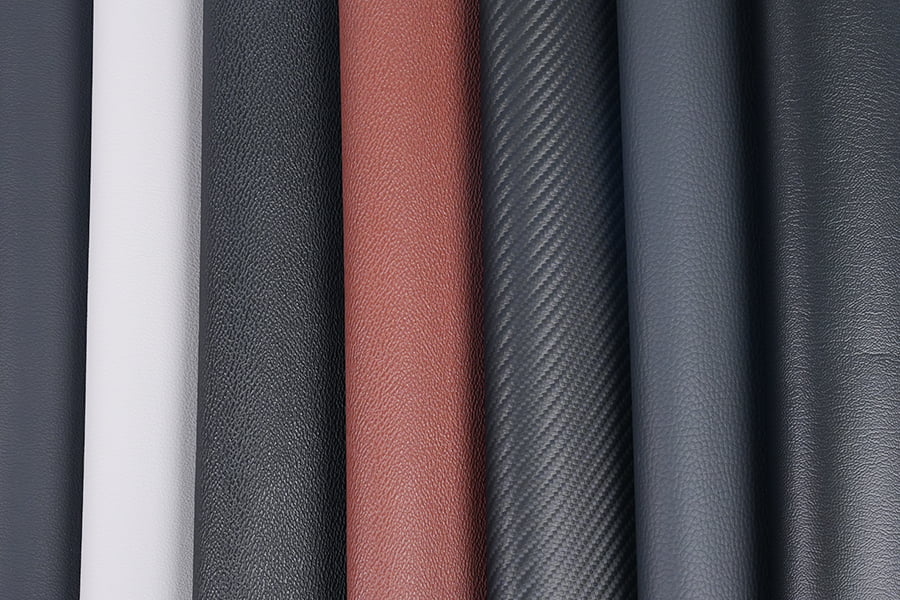 High Wear-Resistant PVC Car Interior LeatherAutomotive PVC/PU upholstery with abrasion resistance, heat-stable options and custom backing/finish choices for seats, door panels and high-slide interior positions.View Product →
The grade we build for seat bolsters, door inserts and dash fascias is engineered around exactly these questions, with a heavy abrasion layer for high-slide positions and a heat-stable compound for sun-facing panels.
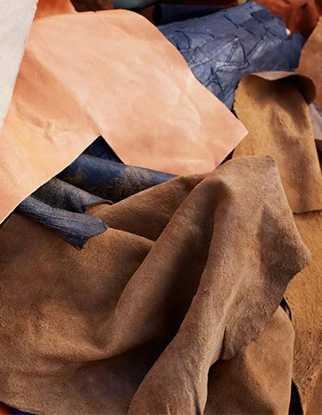 Automotive Synthetic Leather Product RangeBrowse custom automotive PVC synthetic leather grades for seats, door interiors and armrests, plus related synthetic leather categories for sofas, bags, shoes and fitness equipment.View Product →
Buyers planning a full interior programme often specify two or three grades across a single cabin, matching the material to the stress each position will see.
The decision usually comes down to whether the failure is cosmetic or structural.
Repair makes sense when the damage sits in the finish layer: faded colour on a sun-exposed panel, a scuffed bolster, a small puncture, or a seam that has opened without the surrounding material failing. Professional re-colouring and localised patching typically restore appearance for two to three more years, and the cost is a fraction of a retrim.
Replacement becomes the better investment when the base fabric is exposed, when cracking follows fold lines across a wide area, when the surface has gone tacky across an entire panel, or when adhesion has failed over a thermoformed section. At that point the material has passed its design intent and any repair is a short-term patch on a structural problem.
One useful rule of thumb from the production floor: if more than about fifteen percent of a panel's surface has reached the base fabric, retrimming that panel is usually cheaper over a five-year horizon than repeated repairs.
Yes, and it is often conservative. Five years is roughly the point where a daily-driven, sun-exposed interior begins to show noticeable gloss and light surface wear. The material is still fully functional at that stage; appearance, not structural integrity, is what changes first.
In most passenger car applications it does, particularly in high-contact positions. Fabric absorbs spills and holds odour, while a PVC surface wipes clean and resists staining. Fabric tends to fade rather than wear, so the comparison depends on which failure mode bothers the owner more.
Because occupants slide across them on every entry and exit, applying concentrated friction to a narrow strip of material. A bolster can receive ten times the abrasion cycles of the cushion centre over the same period, which is why it should carry the highest abrasion grade in the cabin.
You can slow it substantially but not eliminate it. Cracking is driven by flexibility loss through heat ageing, so the effective measures are shading the car, cleaning with pH-neutral products, applying a UV-protective dressing and keeping the surface free of abrasive grit.
Indirectly, yes. Dark surfaces absorb more solar energy and reach higher peak temperatures, which accelerates heat ageing. Light colours stay cooler but show soiling and dye transfer more readily, so they benefit from a stronger soil-release top coat.
Considerably, in high-friction positions. Moving from a 0.20 mm to a 0.40 mm skin roughly doubles the abrasion reserve and typically adds two years of service life at a bolster. In low-contact positions such as a headliner or a lower door card the benefit is much smaller and rarely justifies the cost.
The perforations themselves are not a weakness, but they do create entry points for liquids and grit. Perforated panels benefit most from prompt spill response and from a protectant that reduces surface tension so liquids bead rather than wick into the holes.
Park in the shade or use a sunshade. Heat and UV together account for a larger share of interior ageing than friction, spills and cleaning combined, and shading the cabin addresses both at once at almost no cost.
Ask for third-party test reports rather than internal summaries, confirm the test method and load conditions, and request the skin thickness at the thinnest point of the sample. A supplier confident in the laminate will provide all three without hesitation.
The Versatility of Sofa Artificial Leather in Different Home Decor Styles Sofa artificial leather has gained significant popularity as a material for home furniture, owing to its impressive versatilit...
View MoreIntroduction to Synthetic Leather What is Synthetic Leather? Definition and overview: Synthetic leather, also known as faux leather, vegan leather, or artificial leather, is a man-made material desig...
View MorePVC (Polyvinyl Chloride) and PU (Polyurethane) are two popular materials used in the production of automotive synthetic leather, each with its unique characteristics. Below are the key differences: Ma...
View MoreIntroduction of Synthetic Leather for Shoes What Is Synthetic Leather? Synthetic leather refers to any man-made material designed to imitate the appearance, texture, and qualities of genuine leather. ...
View MoreCopyright © Fu'an Synthetic Materials Co.,Ltd. Rights Reserved.
 Privacy
Custom PVC Synthetic/Artificial Leather Manufacturers