language

Search

 中文简体
 English
 Español
 عربى
 Indonesia

Inquiry Now 
Content
A seat bolster, a door insert and a dashboard top can all be covered with PVC synthetic leather from the same factory, yet they should almost never carry the same specification. The seat takes repeated compression from body weight, rubbing from clothing seams and denim rivets; the door panel takes keys, rings, elbows and hand cream; the dashboard lives under glass at surface temperatures that can pass 90 °C in summer and drop below -20 °C in winter storage. When one specification is written for all three positions, the trim program usually passes the first sample and fails somewhere in the second or third production batch.
Dominated by abrasion and flex fatigue. The backing fabric and the foam lamination decide almost as much as the PVC surface itself.
Dominated by grain retention, scuff resistance and resistance to sun cream, hand cream and insect repellent.
Dominated by heat ageing, low gloss, fogging control and dimensional stability under constant thermal load.
The practical route is to keep one base PVC compound and one grain family for visual consistency, then write three separate acceptance sheets that differ in thickness, backing weight, surface treatment and test thresholds. That approach keeps colour harmony across the cabin while giving the cutting room and the tier-one trim supplier clear limits for each position.
Most rejection discussions come back to six or seven measurable values. The table below shows the ranges that are commonly quoted in automotive interior specifications for PVC coated leather. They are starting points for a technical conversation, not a substitute for the vehicle manufacturer's own material standard, which always takes precedence.
| Property | Test commonly quoted | Seat | Door panel | Dashboard |
|---|---|---|---|---|
| Surface abrasion | Martindale EN ISO 12947 or Wyzenbeek ASTM D4157 | 50,000 cycles; heavy duty 100,000 | 20,000 to 30,000 cycles | 10,000 to 20,000 cycles |
| Flex fatigue | Bally flexometer, ISO 7854 | 100,000 cycles at -10 °C | 50,000 cycles | 30,000 cycles |
| Cold bend | Mandrel bend, 1.5 to 2 mm | No cracking at -20 °C | No cracking at -20 °C | No cracking at -30 °C |
| Thickness | Micrometer gauge under light load | 1.0 to 1.3 mm | 0.8 to 1.1 mm | 1.0 to 1.4 mm |
| Mass per unit area | Grams per square metre | 550 to 750 | 450 to 650 | 550 to 800 |
| Gloss level | 60° gloss meter | 2 to 6 GU | 1 to 4 GU | 1 to 3 GU |
| Fogging | DIN 75201 or ISO 6452 | Usually not specified | Usually not specified | 2 mg gravimetric or better |
| Flame spread | FMVSS 302, GB 8410 | 102 mm/min or less | 102 mm/min or less | 102 mm/min or less |
Two habits save time here. First, ask for the test method alongside the number, because a Martindale result and a Wyzenbeek result are not convertible. Second, ask for the conditioning time before testing. A PVC sample pulled straight from a cold warehouse and tested within an hour can show a cold bend failure that disappears after 24 hours at 23 °C and 50% relative humidity.
A 50,000-cycle Martindale result on a PVC seat cover generally corresponds to several years of normal family use on a side bolster. The number that matters most is not the headline figure but where the failure occurs: surface colour loss, grain flattening, or a crack that starts at the coating and reaches the backing. Colour loss within 2,000 cycles points to a weak top coat; grain flattening within 10,000 cycles points to a compound that is too soft for the position.
PVC synthetic leather is a composite. A 1.1 mm coating on a 150 g/m² knitted backing behaves very differently from the same coating on a 220 g/m² woven backing. Knitted backings give stretch and a soft hand, which suits curved bolsters and sew lines. Woven backings give dimensional stability and higher tear strength, which suits flat cushion panels and heavy-duty applications. When a seat cover fails at the seam rather than on the surface, the backing specification is usually the place to look first.
Perforated PVC is popular for ventilation and appearance, but each hole interrupts the surface film. For a perforated seat, many programs move from a 1.0 mm to a 1.2 mm coating and reduce hole diameter slightly to protect the mechanical result. Perforation also changes cleaning behaviour, so the maintenance instruction inside the owner's manual should match the actual hole pattern rather than a generic text block.
Door panels are rarely the most technical part of an interior, but they generate a remarkable share of warranty complaints. The failure pattern is consistent: a shallow grain that polishes flat within two years, a scuff mark from a shoe or a bag that cannot be removed, or a surface that turns tacky after repeated contact with sun cream and insect repellent.
For door inserts that sit next to decorative film or fabric, colour match should be checked under three light sources: daylight at 6500 K, showroom lighting at 4000 K, and warm interior lighting at 3000 K. A match that passes only under one source will be visible in the showroom, which is where most customers make their judgement.
The dashboard is the position where PVC synthetic leather has to prove itself over the longest period with the least maintenance. A dark dashboard under glass can reach surface temperatures that soften many polymers, and any volatile component in the compound will migrate to the windshield as a fog film. Two specifications do most of the work: heat ageing and fogging.
Heat ageing is normally written as 500 hours at 100 to 120 °C with a check for colour shift, cracking, shrinkage and gloss change. Fogging is measured either gravimetrically, where the condensed deposit is weighed, or photometrically, where the light transmission of the fogged glass is compared with a clean reference. For a matte, low-gloss PVC top skin, gloss readings of 1 to 3 units at 60° keep reflections off the windshield and reduce the visible ageing of the surface.
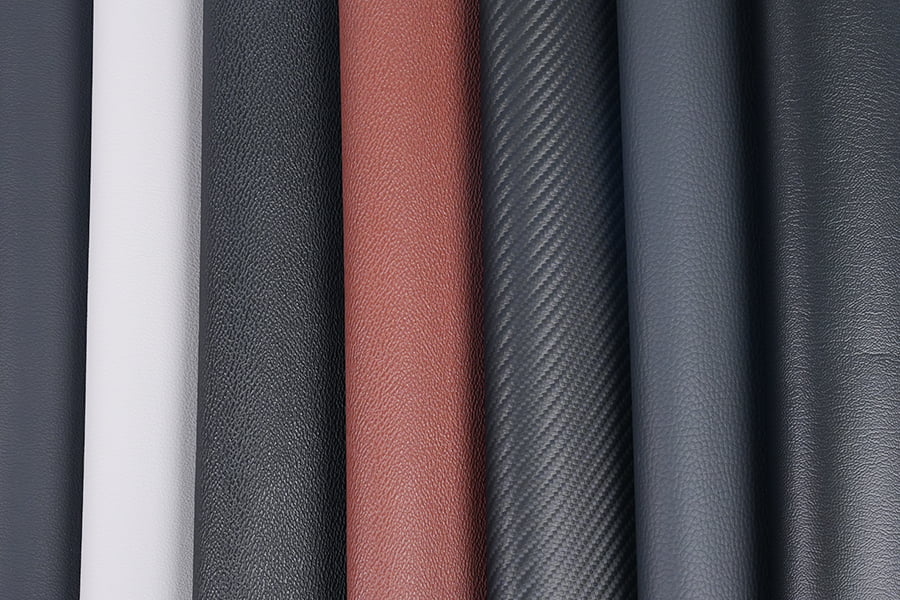 High Wear-Resistant PVC Car Interior LeatherReview this automotive PVC upholstery option for seats, door panels and armrests, with matte finishes and backing choices relevant to low-gloss interior trim.View Product →
Where the dashboard design includes a soft-touch upper section over foam, the PVC skin also has to survive the foam-in-place process without grain collapse. That usually means a slightly higher plasticiser retention and a controlled pre-heat step at the trim supplier. Discussing this with the material supplier before the tool is cut is far cheaper than correcting a collapsed grain after launch.
Cold performance is where a supplier's compounding discipline becomes visible. PVC synthetic leather for automotive use is commonly required to pass a mandrel bend at -20 °C, and some programs ask for -30 °C on components that are stored or shipped through cold climates. A batch that was produced with an inconsistent plasticiser dispersion can pass in summer and crack in winter, which is why the cold bend test belongs in routine batch release rather than only in the initial approval.
Hot and humid conditions produce a different challenge. Unlike polyurethane, PVC does not hydrolyse, so a PVC interior surface keeps its mechanical properties in a humid cabin over many years. That stability is one reason PVC remains a mainstream choice for entry and mid-range vehicle interiors, taxi fleets and ride-hailing vehicles that accumulate high mileage quickly. The related limitations, such as plasticiser migration and fogging, are controlled through compound design and are already covered by the heat ageing and fogging tests described earlier.
For a deeper technical view of low-temperature behaviour and how to write a cold-weather specification, the notes in maintaining low-temperature flexibility are a useful reference during sample review.
FMVSS 302 sets a horizontal burn rate limit of 102 mm per minute for interior materials in the United States, and GB 8410 applies a comparable requirement in China. Most reputable PVC automotive leathers clear this comfortably when the compound contains an appropriate flame retardant package and the backing is selected with care. The test is simple; the difficulties usually appear in three places.
Odour is the other half of cabin air. A PVC leather with a clean, low-odour compound and adequate devolatilisation at the calender will pass most in-vehicle odour panels without extra treatment. If an odour complaint appears after a change of plasticiser supplier, the fastest diagnostic is to compare a retained sample from the previous batch side by side under the same conditioning time.
Purchasing teams often compare price per metre when the real comparison is cost per finished part. Roll width, roll length, grain direction and the number of join points per roll all change the yield in the cutting room. A 1,420 mm roll that leaves 30 mm of unusable edge on each side produces less usable area than a 1,370 mm roll with a clean edge, even though the headline width looks better.
| Item | Common option | Practical note |
|---|---|---|
| Roll width | 1,370 mm, 1,420 mm, 1,500 mm | Match the roll width to the nesting layout before ordering |
| Roll length | 30 m, 40 m, 50 m | Longer rolls reduce join losses but increase handling weight |
| Core diameter | 76 mm paper or plastic core | Confirm the unwinder on the cutting table |
| Grain direction | Along the roll length | Mark clearly, since cross-grain cutting changes stretch |
| Protective layer | PE film plus kraft paper | Prevents pressure marks in stacked storage |
| Container loading | Rolls on pallets or hanging | Hanging avoids flat spots on soft grades |
Automotive colour approval is stricter than furniture or bag colour approval. A colour difference of about 1.0 ΔE is a workable target for interior trim, and many programs ask for 0.8 or better between successive batches. Reaching that level requires three things: a retained master sample, a documented pigment formula, and a spectrophotometer reading taken under a defined light source rather than a visual check at the end of the line.
Grain development deserves the same discipline. A new grain is usually produced from a embossing roller or a release paper, and the first production run rarely matches the design intent exactly because of shrinkage during cooling. Building a 3 to 5% allowance into the artwork and approving the grain on a finished, laminated sample prevents most of the mismatch complaints that appear during pilot builds.
Batch consistency also depends on how the material is stored before use. Rolls kept in a cold, unheated warehouse for several weeks should be allowed to reach room temperature before cutting, and rolls stored flat for long periods may develop pressure marks on soft grades. Rotating stock and using the oldest batch first is a simple control that prevents a surprising number of surface complaints.
A typical automotive interior program runs through several sample stages before series supply. Each stage has a purpose, and skipping one usually transfers the risk to the production line.
Two documents make this workflow faster. The first is a one-page test summary that lists every property, the method, the target and the actual result. The second is a defect reference sheet with photographs of acceptable and unacceptable surface conditions, because written descriptions of "slight grain variation" are interpreted differently by every inspector.
| Defect | Likely cause | First action |
|---|---|---|
| Faint grain lines on the surface | Embossing roller temperature drift | Check roller temperature log and embossing pressure |
| Colour drift between rolls | Pigment dispersion or dosing variation | Compare spectrophotometer readings against master |
| Surface tackiness after storage | Plasticiser migration or incomplete fusion | Review fusion temperature and storage conditions |
| Cracking at the fold | Low cold flexibility or heavy filler loading | Re-run cold bend at the specified temperature |
| Visible haze on the windshield | Volatile content above fogging limit | Re-test fogging and review raw material batch |
 Automotive Synthetic Leather Category and Related ApplicationsBrowse the automotive synthetic leather category, featuring a custom PVC car interior item and related synthetic-leather categories for sofas, bags, shoes and fitness equipment.View Product →
Most supply interruptions in this product category come from assumptions rather than technical failures. Confirm the following before the purchase order is issued, and record the answers in the order confirmation.
For projects that combine several positions in one cabin, ordering all positions from a single production batch reduces colour variation to near zero. Where that is not possible, sequencing the batches so that seats, door panels and dashboards are cut from consecutive runs keeps the visual difference below what a customer would notice.
Yes, when the compound is designed for it. PVC does not hydrolyse, so humidity is not the concern it is for some other materials. What matters is heat ageing, plasticiser retention and gloss stability. A specification with 500 hours at 100 °C and a fogging limit covers the main risks, and a matte top coat keeps the surface from becoming reflective and sticky in strong sun.
Most passenger-car seat programs ask for at least 50,000 Martindale cycles, and heavy-duty or fleet applications often ask for 100,000. The test method matters: Martindale and Wyzenbeek figures cannot be converted directly. Ask for the method, the conditioning time and the failure mode, not just the number.
It can. Fogging is controlled through raw material selection and adequate devolatilisation during production. A gravimetric result of 2 mg or lower is a common target, and photometric results above 80 to 90% transmission are also used. Testing should be done on the finished composite because foam and adhesive layers contribute to the result.
Door inserts commonly run between 0.8 and 1.1 mm, with armrest areas at the upper end of that range. The choice depends on how the panel is assembled: a wrapped insert with a deep draw needs more stretch, while a flat bonded insert can use a firmer, thinner material.
For a grain that already exists on the supplier's roller set, a colour match typically takes two to three weeks including sample shipment. A completely new grain requires artwork, roller or release paper production and trial embossing, which usually adds four to six weeks. Building this into the program timeline early avoids compressing the pilot stage later.
It changes the mechanical result, so the specification should be adjusted rather than reused. A perforated seat cover is often specified with a slightly thicker coating and a smaller hole pattern to keep abrasion and tear results stable. Cleaning instructions should also match the perforation pattern.
Store them upright or hanging where possible, in a dry space between 10 and 30 °C, away from direct sunlight and heat sources. Allow cold rolls to reach room temperature before unwinding, and use stock in rotation. Flat stacking of soft grades over long periods is the most common cause of pressure marks found at the cutting table.
The Versatility of Sofa Artificial Leather in Different Home Decor Styles Sofa artificial leather has gained significant popularity as a material for home furniture, owing to its impressive versatilit...
View MoreIntroduction to Synthetic Leather What is Synthetic Leather? Definition and overview: Synthetic leather, also known as faux leather, vegan leather, or artificial leather, is a man-made material desig...
View MorePVC (Polyvinyl Chloride) and PU (Polyurethane) are two popular materials used in the production of automotive synthetic leather, each with its unique characteristics. Below are the key differences: Ma...
View MoreIntroduction of Synthetic Leather for Shoes What Is Synthetic Leather? Synthetic leather refers to any man-made material designed to imitate the appearance, texture, and qualities of genuine leather. ...
View MoreCopyright © Fu'an Synthetic Materials Co.,Ltd. Rights Reserved.
 Privacy
Custom PVC Synthetic/Artificial Leather Manufacturers